Keep Every Bin Clear and Prove It

Supervisors inspect bins against your contract criteria, fix what they can on the spot and send the rest to the right team. Collection crews and trucks run in the same system, and every record carries photos, GPS and the bin’s ID.
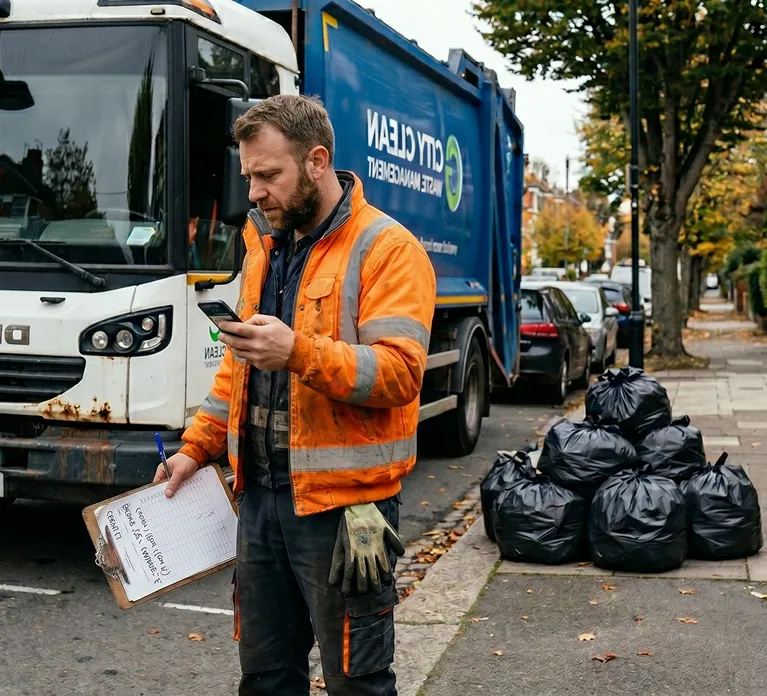

Sanitation worker in a reflective jacket checking a phone next to a waste collection truck

The problem

Why Non-Compliance Is Found Too Late

Municipal contracts judge you on the state of every bin: overflowing, damaged, dirty or surrounded by litter. Most operators only find out when the municipality or a resident reports it.

Paper checklists and photos sent over chat can’t prove which bin was checked, or when. Follow-ups get lost between supervisors and maintenance crews. And targets are counted at the end of the month, when it’s too late to act.

Worker in a safety vest using a tablet next to a row of green waste bins

How it works

From Planning to Inspection to Monitoring

Every step runs on the same field data, so nothing is counted by hand.

  1. Plan

    Supervisors start the shift with their routes and daily inspection targets. Drivers, helpers and trucks are dispatched to their collection routes.

  2. Inspect and fix

    Supervisors scan each bin, work through your checklist and fix what they can. Anything left open becomes a task for the right team.

  3. Monitor

    The control room follows inspections, open tasks, targets, attendance and dispatch across every region, and acts before a problem is reported.

Mobile app

Supervisors Carry Every Route in Their Pocket

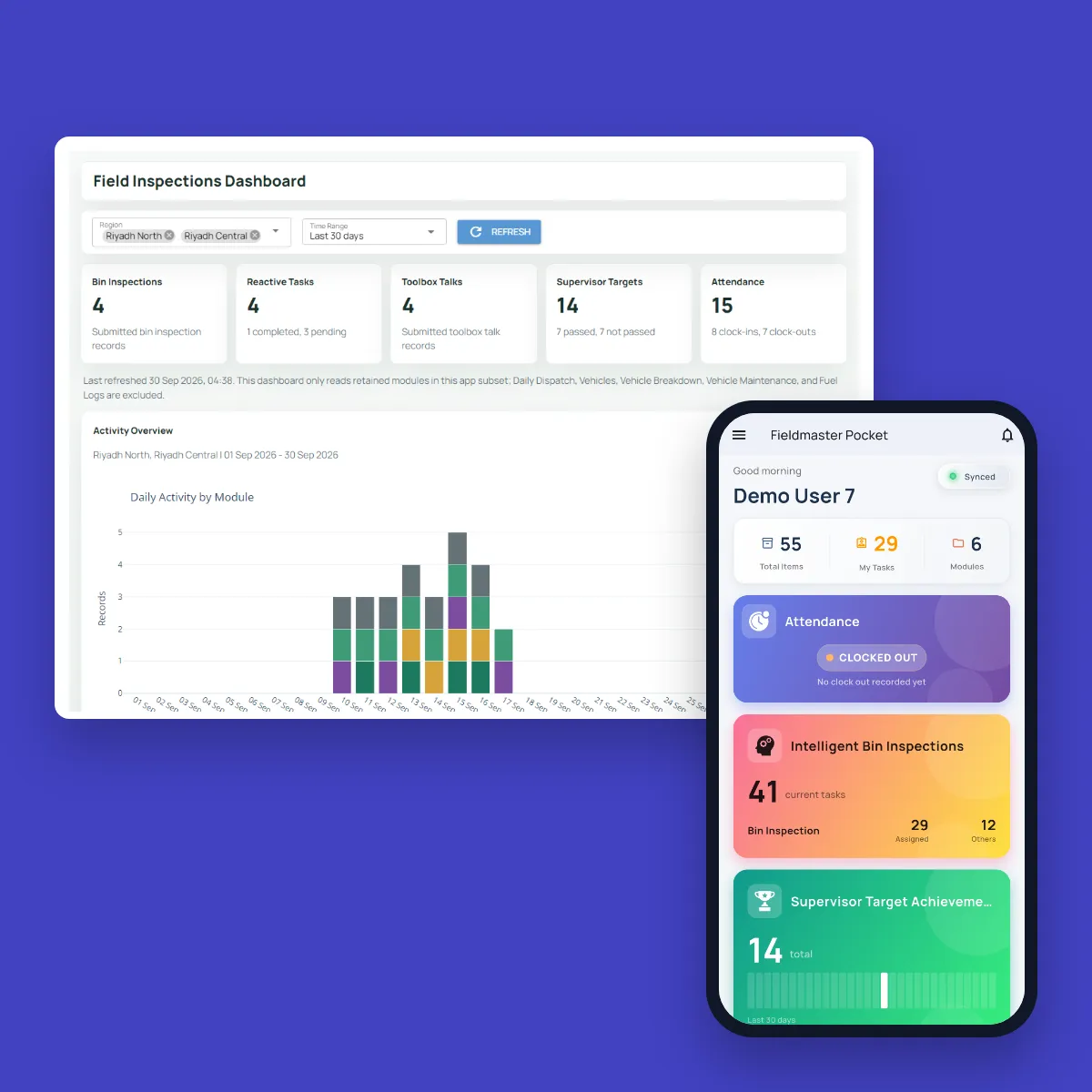
Supervisors see the bins for their shift on a map, scan each bin’s ID, talk through what they see and answer the contract checklist in the Fieldmaster Pocket app. Their daily scorecard is on the same home screen.

Every inspection and fix reaches the control room dashboard as soon as it’s saved. The app works without signal and in each supervisor’s own language.

Field inspections dashboard with bin inspections, follow-up tasks, supervisor targets and attendance, next to the Fieldmaster Pocket home screen of a supervisor

Proof

Proven on a City-Wide Contract

Numbers from a waste management contractor in the GCC that runs its bin operations on Fieldmaster every day.

  • 35,000+

    Bins under management

    Every bin registered with its location and full inspection history.

  • 200+

    Bins inspected every day

    Each with a scanned bin ID, GPS-stamped photos and a timestamp.

  • 55

    Follow-up tasks a day, created automatically

    Any issue not fixed on the spot becomes a task the moment the inspection is submitted.

Results

What Changes for Your Operation

  • Fewer penalties

    Overflowing, damaged and dirty bins are found and fixed by your team before the municipality finds them.

  • Proof for every dispute

    Every inspection and fix is backed by the bin’s ID, photos, location and time.

  • No lost follow-ups

    Issues not fixed on the spot go to the right supervisor or maintenance crew, with the photos attached.

  • Supervisors held to daily targets

    Each supervisor sees their targets and score for the day. Managers see who passed and who didn’t.

  • Collections run to plan

    Crews and trucks are dispatched to their routes each shift, with idle trucks and absences recorded.

  • Trucks ready for every shift

    Vehicle checks at clock-in and repair deadlines for breakdowns keep the fleet on the road.

Why field focus matters

What Happens When Crews Are Left Out

When the contract checklist lives on paper and follow-ups live in a chat group, you hear about problems from the municipality, and you can’t prove the work your crews did.

  • A pile of rubbish bags and food packaging spilled on a sunlit street beside two yellow wheeled bins, with parked cars behind.

    Penalised for a bin that was clear at nine

    A resident posts an overflowing bin at noon, the municipality issues a penalty, and you have nothing to show it was cleared that morning.

  • A yellow street bin knocked loose and tilted on its post, with rubbish bags and litter spread on the pavement below.

    Chasing fixes nobody confirms

    Broken lids and spills are posted to a chat group, and you spend the day asking whether anyone dealt with them.

  • A close view of a hand holding a pen over a blue clipboard, filling in a paper form.

    Inspection reports you can’t trust

    Supervisors fill in the route from memory at the end of the shift, so you can’t tell which bins were really checked until a complaint shows one wasn’t.

  • A small municipal rubbish truck piled high with bags of waste, parked on a street in front of a painted wall.

    Missed streets you hear about from the client

    A truck skips a street or runs late, and the first you know of it is the municipality’s complaint, then the penalty.