

An HSE management system is the set of policies, processes and records a company uses to manage health, safety and environmental risk in its work. It covers how hazards are found and reported, how incidents are investigated, how sites are inspected, how high-risk work is controlled, and how the actions that follow are closed.
It is a way of working, not a product. Software can run it, and a standard such as ISO 45001 can describe it, but the system itself is what your people do every day on site.
What HSE Stands For
HSE means health, safety and environment. You will see the same idea under other names: EHS (the same three words in a different order), QHSE (with quality added), a safety management system, or an occupational health and safety management system, which is the wording ISO 45001 uses.
The names change by country and industry. In oil and gas and in contracting across the GCC, “HSE” is the usual one.
What an HSE Management System Covers
The details vary by company, but most systems have the same parts:
- Policy and responsibilities. What the company commits to, and who is accountable for what.
- Hazard identification and risk assessment. Finding what could hurt people or the environment, and deciding how to control it.
- Observation and near-miss reporting. Anyone on site can report an unsafe act or condition before it causes harm.
- Incident reporting and investigation. What happened, why it happened and what will stop it happening again.
- Inspections and audits. Planned checks of sites, equipment and practices against a standard.
- Control of high-risk work. Permits to work for jobs such as hot work, work at height, confined space entry and excavation.
- Training and communication. Inductions, competence records and toolbox talks.
- Corrective actions. Every finding gets an owner and a due date, and is checked when it is closed.
- Measurement and review. Indicators that show whether the system is working, reviewed by management.
A system is only as strong as its weakest part. A site with excellent inspections and no follow-up on the findings does not have a working system.
Plan, Do, Check, Act
Most HSE management systems follow the same loop, which is also the structure behind ISO 45001 for occupational health and safety and ISO 14001 for environmental management:
- Plan. Identify hazards, assess risks and set objectives.
- Do. Put the controls in place: procedures, permits, training and equipment.
- Check. Inspect, audit, investigate incidents and measure performance.
- Act. Fix what the checks found, and improve the system.
The loop matters more than any single document. A company that inspects and never acts has stopped at step three.
How Performance Is Measured
HSE performance is tracked with two kinds of indicator.
Lagging indicators count harm that has already happened. The two most common are:
- TRIR, the total recordable incident rate. It is commonly calculated as recordable incidents multiplied by 200,000, divided by the hours worked.
- LTIF, the lost time injury frequency. It is commonly calculated as lost time injuries multiplied by 1,000,000, divided by the hours worked.
Clients often ask contractors for these figures in tenders and monthly reports.
Leading indicators count the activity that prevents harm: observations reported, inspections completed, toolbox talks held, and corrective actions closed on time. They tell you where the next incident is likely to come from, while there is still time to prevent it.
Where Paper Systems Break Down
Many companies have a sound HSE management system on paper and a weak one in practice. The gaps are usually the same:
- Observation cards are filled in on paper, if at all, and typed up after the shift.
- Workers who do not read or write English well stop reporting.
- Inspection findings sit in one spreadsheet and incident actions in another, and nobody can say which were fixed.
- Corrective actions are closed with a line of text and no proof.
- Toolbox talks are read out in one language and signed on a sheet, so nobody can show who understood them.
- TRIR and LTIF are worked out in a spreadsheet at month end, from figures nobody can trace back to a record.
None of these is a failure of policy. They are failures of the reporting loop between the site and the office.
What HSE Management Software Adds
HSE management software runs the same processes on phones and the web. It does not replace the system; it closes the loop:
- Reports are made on the spot. A worker raises an observation with a photo or a spoken sentence, in their own language, with or without signal.
- Findings become actions. Each accepted finding gets an owner, a priority and a due date.
- Fixes are proven. An action is closed with a photo and verified by someone other than the person who did the work.
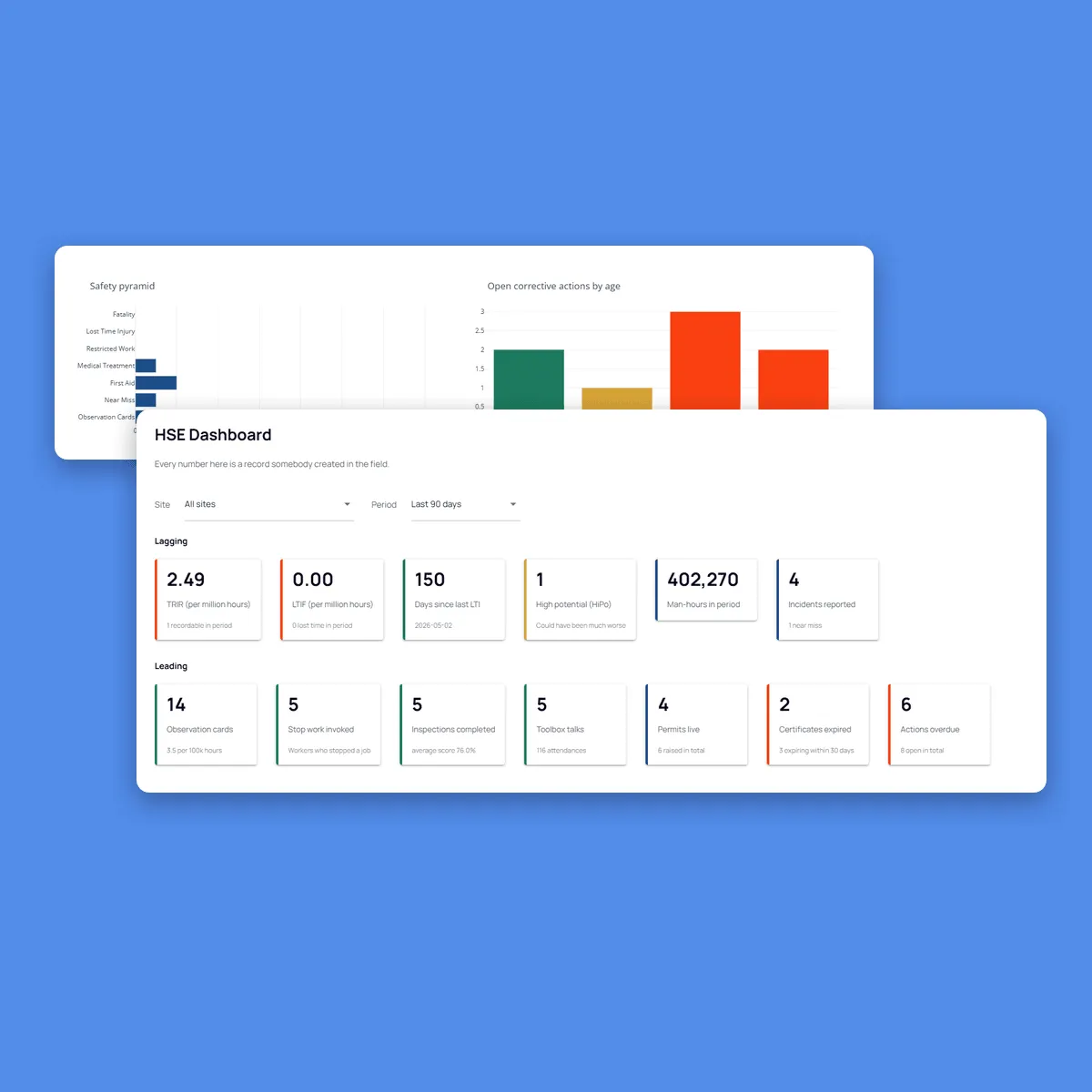
- Figures come from records. Rates such as TRIR and LTIF are calculated from the incidents and man-hours in the system, so each number can be traced.
- Every site works the same way. One set of checklists and categories, with each supervisor seeing their own sites.
Is ISO 45001 Required?
ISO 45001 is a voluntary international standard. A company can run a sound HSE management system without being certified, and certification does not guarantee a safe site. Many clients do ask for it in tenders, which is why contractors pursue it.
Software is not a certification either. What it can do is keep the records a certified system relies on: hazard reports, inspections, investigations, corrective actions and training records, each showing who did what and when.
How to Get Started
If your system lives on paper today, do not try to move everything at once:
- Start with observation and near-miss reporting on one site, because it is the part most often missing.
- Add inspections with a fixed checklist, and send every failed item to a named owner.
- Track corrective actions to closure, with a photo of the finished fix.
- Add incidents, permits and training records once the first three are routine.
The aim of the first month is simple: more reports from the field, and no finding without an owner.
How Fieldmaster Approaches It
Fieldmaster builds the app around your own observation categories, inspection checklists and approval stages. Workers report hazards, near misses and incidents by voice or photo, in their own language and without signal. Inspections, investigations, toolbox talks and permits run in the same app, every accepted finding becomes a corrective action with an owner and a due date, and TRIR and LTIF are calculated from the records.
You can see the details on our HSE management system page, read how permits are controlled in the permit to work use case, or talk to us about your sites.