.png)
Why Legacy Systems Are Limiting Your Business Potential

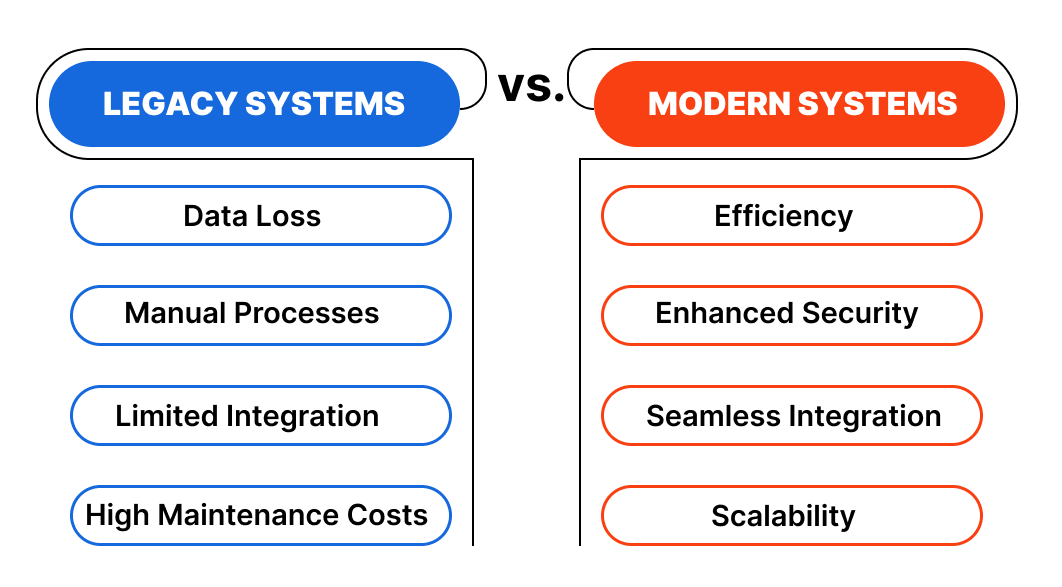
Legacy IT systems, once essential, are now barriers to business growth. They introduce inefficiencies, delay decision-making, and hinder scalability. Sticking with outdated systems prevents businesses from staying competitive and responsive to market shifts.
The Problem with Legacy IT Systems
- Slow Decision-Making: Legacy systems often store data in separate, outdated platforms that don’t talk to each other. This creates delays in accessing critical information, slowing down your ability to make decisions in real time.
- Manual Processes: A lot of tasks that could be automated are still done manually. From data entry to task management, these processes waste time, reduce accuracy, and increase costs.
- Scaling Challenges: As your business grows, legacy systems struggle to scale. They weren’t built for the demands of modern, fast-moving organizations, leading to costly workarounds and inefficiencies.
- Security & Compliance Risks: With outdated security measures, legacy IT systems leave your business vulnerable to data breaches and compliance failures. This can result in fines and damage to your reputation.
How Modern Operations Management Software Solves These Problems
Switching to modern operations management software solves these issues by automating tasks, unifying data, and providing real-time insights.
- Unified Data: Instead of using multiple systems, a modern solution brings everything into one place. This enables quick access to data, speeding up decision-making and improving accuracy.
- Automated Tasks: Automating manual processes like scheduling, task assignment, and reporting frees up valuable time for employees to focus on high-priority work, reducing mistakes and costs.
- Scalable Solutions: Modern software is designed to grow with your business. You can add new functions and scale seamlessly without worrying about system limitations or manual interventions.
- Better Security & Compliance: Modern systems come with built-in security features and automated compliance tracking, helping you protect sensitive data and meet industry regulations.
Taking the Step Toward Modern Software
Making the switch from legacy systems doesn’t have to be overwhelming. Here's how to get started:
- Identify Pain Points: Find the areas where legacy systems are causing the most issues. Is it slow decision-making? Manual data entry? Identify these inefficiencies and look for software solutions that address them.
- Choose the Right Solution: Pick a modern system that integrates well with your current processes. It’s about enhancing what works and eliminating inefficiencies.
- Train Your Team: Ensure your team is ready for the transition. Invest in training to make sure they can take full advantage of the new system and its capabilities.
- Scale Over Time: Start with the critical areas where you need the most improvement. Once you see the benefits, gradually expand the system’s usage across the organization.
Why FieldMaster.ai Is the Right Choice
At FieldMaster.ai, we saw how much time and potential organizations were losing to rigid, outdated systems that no longer fit how teams work. Operations leaders were spending more time managing manual processes and disconnected tools than focusing on growth.
We built FieldMaster.ai to change that , to help businesses move beyond legacy limitations, unify their data, and give teams the clarity, visibility, and control to operate confidently in real time. Our purpose is simple: to replace complexity with clarity, so every decision and action moves your business forward.
FieldMaster.ai breaks free from the limitations of legacy IT systems with real-time insights, automated workflows, and unified operations giving your business the flexibility to scale without compromising on security or performance.
By transitioning to FieldMaster.ai, you can modernize operations, improve decision-making, and stay ahead of competitors. With seamless integration, enhanced task management, and built-in compliance, your operations run faster, smarter, and more securely without the weight of outdated systems.
.png)

"Fieldmaster.ai transformed how we manage our operations across multiple sites. The accuracy we gained from field-first data collection eliminated costly mistakes and saved us months of reconciliation work."
Ready to transform operations
Discover how Fieldmaster helps companies like yours achieve field KPIs with precision and speed.

Stay ahead in the field
Get insights and strategies delivered to your inbox every week from Fieldmaster .
FAQs
Questions about field-first data and how Fieldmaster works
Field-first data is information captured at the source, where work actually happens. Instead of relying on reports compiled hours or days later, it's collected in real-time by workers on the ground. This approach eliminates the gaps and inaccuracies that come from office-based data collection.
FieldMaster AI's mobile app functions completely offline. Workers collect data without internet connectivity, and when the connection returns, all information syncs automatically. Nothing is lost, and operations continue uninterrupted regardless of network conditions.
Yes. Our native mobile app is built with zero-effort multilingual support. Workers of any ethnicity or language background become instantly familiar with the interface. There's no language barrier to adoption or understanding.
It means each user sees only the information relevant to their role. A supervisor has different access than a manager, who has different access than a field worker. This keeps operations organized and ensures people focus on what matters to them.
We've been in business since 2015, starting as field contractors ourselves. That experience shaped everything we built. We've added over $200 million in value to projects across the GCC by focusing on what actually works in the field.