.png)
Overbooked and Understaffed? How Ops Teams Use Engineer Scheduling Platforms
-Picsart-AiImageEnhancer.png)
Schedules change. Engineers run behind. Workloads pile up. And somehow, everything still lands on the ops team’s plate.
If you’re constantly rearranging tasks, chasing updates, or wondering who’s free to pick up the next job—it’s probably not a staffing problem. It’s a scheduling system problem.
The issue isn’t just availability. It’s about knowing which team member has the actual capacity to take on more work, complete it within SLA, and still stay on track. That’s why more teams are turning to engineer scheduling platforms that prioritize workload balance, real-time visibility, and intelligent task assignment.
Why Traditional Scheduling Tools Break Down
Spreadsheets, calendars, and chat groups were never designed for operations at scale. These tools don’t account for things like job duration, task complexity, technician skill levels, or current workload. They only show you who’s "free" not who’s overloaded or best suited for the job.
This leads to constant reshuffling, missed targets, and team burnout. Ops leads are stuck in firefighting mode instead of running a predictable schedule.
What Engineer Scheduling Platforms Do Differently
Modern scheduling platforms are built to reflect real-world conditions. They look beyond static assignments and instead adjust based on:
- Active jobs and task load per person
- Job duration patterns and completion history
- Technician skills and certifications
- Live location and availability
- Priority flags and SLA requirements
The result? Fewer delays, better balance, and less stress for everyone involved.
Top Features That Help Manage Technician Workloads
Here’s what operations teams rely on in a robust engineer scheduling platform:
- Load-aware task assignment: Distributes work based on real-time availability and task complexity
- Skill-based routing: Ensures the right person is doing the right job
- Live dashboards: Provide full visibility into job progress and task status
- SLA tracking: Flags issues before they become breaches
- Approvals and documentation: Centralizes all job-related records in one place
- Built-in analytics: Helps you identify delays, gaps, and trends across operations
These tools aren’t add-ons—they’re essential for modern operations.
So what does this all add up to? Here's what teams actually see once they start using smarter scheduling systems:
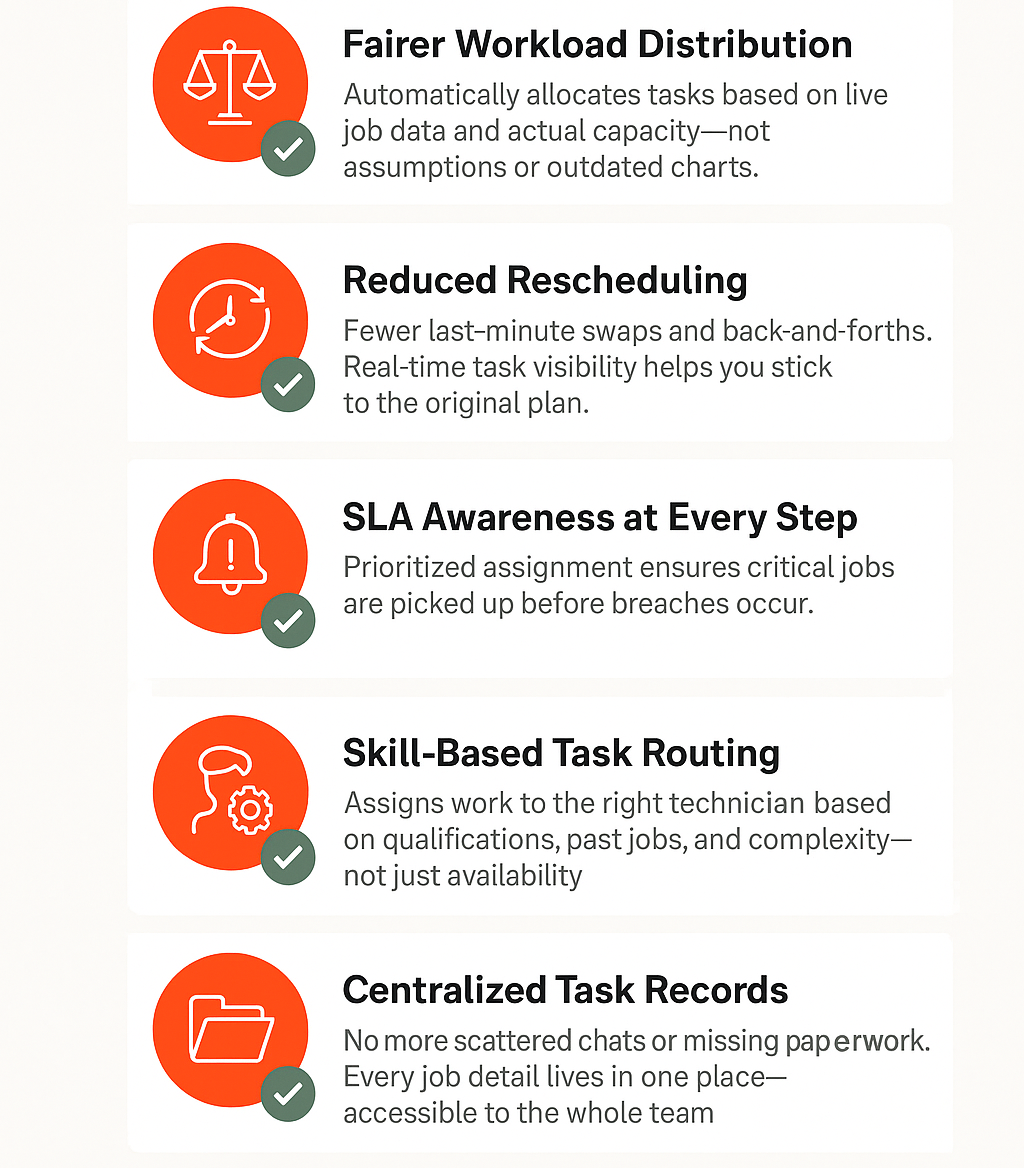
How to Handle Overbooking Without Adding Headcount
Ops teams often search for ways to "optimize resources" or "do more with less." But the truth is, most teams already have the capacity—they’re just missing a system that allocates it properly.
Task assignment software powered by live job data helps distribute work fairly and realistically. It stops overload before it starts and helps managers schedule based on facts, not assumptions.
Choosing the Right Scheduling Tools for Operations Teams
When looking at scheduling tools, skip anything that only offers static calendars. Look for platforms that:
- Automatically update schedules based on workload and availability
- Provide real-time task status and technician visibility
- Connect task assignment to documentation, reporting, and compliance
- Give managers control without micromanagement
- Offer scalable options as your team grows
This is how modern operations are moving beyond chaos—toward predictability, transparency, and performance.
Conclusion
Ops teams aren’t solving overbooking with more people. They’re solving it with better systems.
By adopting engineer scheduling platforms that support real-time logic, workload awareness, and live tracking, they’re able to assign work more intelligently—and avoid the constant cycle of rescheduling, delays, and missed targets.
.png)

"Fieldmaster.ai transformed how we manage our operations across multiple sites. The accuracy we gained from field-first data collection eliminated costly mistakes and saved us months of reconciliation work."
Ready to transform operations
Discover how Fieldmaster helps companies like yours achieve field KPIs with precision and speed.

Stay ahead in the field
Get insights and strategies delivered to your inbox every week from Fieldmaster.
FAQs
Questions about field-first data and how Fieldmaster works
Field-first data is information captured at the source, where work actually happens. Instead of relying on reports compiled hours or days later, it's collected in real-time by workers on the ground. This approach eliminates the gaps and inaccuracies that come from office-based data collection.
FieldMaster AI's mobile app functions completely offline. Workers collect data without internet connectivity, and when the connection returns, all information syncs automatically. Nothing is lost, and operations continue uninterrupted regardless of network conditions.
Yes. Our native mobile app is built with zero-effort multilingual support. Workers of any ethnicity or language background become instantly familiar with the interface. There's no language barrier to adoption or understanding.
It means each user sees only the information relevant to their role. A supervisor has different access than a manager, who has different access than a field worker. This keeps operations organized and ensures people focus on what matters to them.
We've been in business since 2015, starting as field contractors ourselves. That experience shaped everything we built. We've added over $200 million in value to projects across the GCC by focusing on what actually works in the field.