.png)
Why the MSP Model Works Better Than SaaS for Real-World Operations in Utilities, Logistics, and More
.jpg)
In the world of enterprise software, most solutions follow the SaaS model—tools delivered with standard feature sets, leaving teams to configure and adapt them on their own. But real-world operations don’t follow templates. Every organization has its own assignment logic, field constraints, approval flows, and reporting needs. That’s where the MSP (Managed Service Platform) model steps in.
Unlike traditional SaaS, an MSP model doesn’t just provide software—it delivers a continuously managed platform where the technology, workflows, and operational oversight are tightly aligned. It’s a delivery model that combines product + configuration + expert support, so organizations aren’t burdened with making the system work; they get a system that works out of the box—and evolves as their needs evolve.
Most SaaS platforms, while flexible in theory, begin to crack when exposed to the operational noise of actual fieldwork and execution pressure. The MSP model shows its value not in UI screenshots or generic features—but in how precisely it maps to what teams need to get done every day.
1. Workflows That Start Clean
Any workflow is only as strong as its first step. When initiation begins with incomplete or unstructured data, the cost trickles downstream—causing delays in assignment, validation, and execution. The MSP model reduces that friction by structuring initiation itself: pulling essential details like location, type, and urgency directly into the task setup.
This isn’t about making users do more up front—it’s about reducing errors that show up later. In cases of bulk initiations, Excel uploads take care of scale without compromising structure. For regions with exceptions or high priority requirements, the platform handles it in stride—not as a workaround.
2. Assignment Logic That Reflects Field Realities
Task assignment shouldn’t rely on memory, guesswork, or follow-up calls. When geography, asset type, or timelines are part of the workflow, assignment logic must respond to that in real time. In a managed platform, assignments happen based on defined rules, and reassignments don’t require back-end intervention. Whether it’s a scheduled inspection or a last-minute reallocation, the system adjusts without disrupting the larger process.
3. Approvals That Mirror Operational Logic
No two organizations route approvals in the same way—and yet, most SaaS platforms expect them to. With an MSP model, approval workflows are configured to reflect how teams actually work: who signs off on what, how deviations are handled, and where escalation rules apply.
The platform doesn’t just record approvals—it adapts to them. When exception handling, regional coordination, or workflow reconfiguration is required, it’s built in—not bolted on.
4. Insights That Don’t Need Extra Tools
Most platforms offer reporting. The problem is, those reports often sit outside the workflow and require additional tools or manual collation. Here, performance tracking, audit comparisons, trend mapping, and geo-based insights are embedded in the process itself. Data isn't exported, transformed, and analyzed separately—it’s already structured for review.
This allows for real-time operational clarity—where decision-makers don’t just see what’s happening, but also understand why.
5. Traceability That Doesn’t Rely on Trust
Audits, handovers, and compliance checks require a verifiable trail. A managed platform ensures that these trails are automatic and immutable. Whether it’s converting legacy documents into structured formats, tracing user actions, or presenting a complete history of a case, nothing relies on manual recordkeeping or memory.
The audit log is not a feature—it’s the backbone.
6. Integration That Doesn't Break Context
Field operations don’t happen in silos. Platforms need to work seamlessly with internal systems, external data sources, and geospatial tools. An MSP model doesn’t require context switching—external sources feed directly into workflows, maintaining consistency from task creation to closure.
The result is a system that works like a team—not a set of tabs.
7. Change Requests Measured in Days, Not Quarters
Static software models don’t keep up with dynamic operational needs. When teams need a new approval step, document type, or route logic, it can’t wait for a roadmap update. Managed platforms are built for fast response—changes are implemented within defined windows, often in under two weeks, without derailing live operations.
It’s not about saying “yes” to every request. It’s about having a delivery structure that can act quickly when the “yes” is already clear.
Key capabilities that make MSP software essential for modern operations-
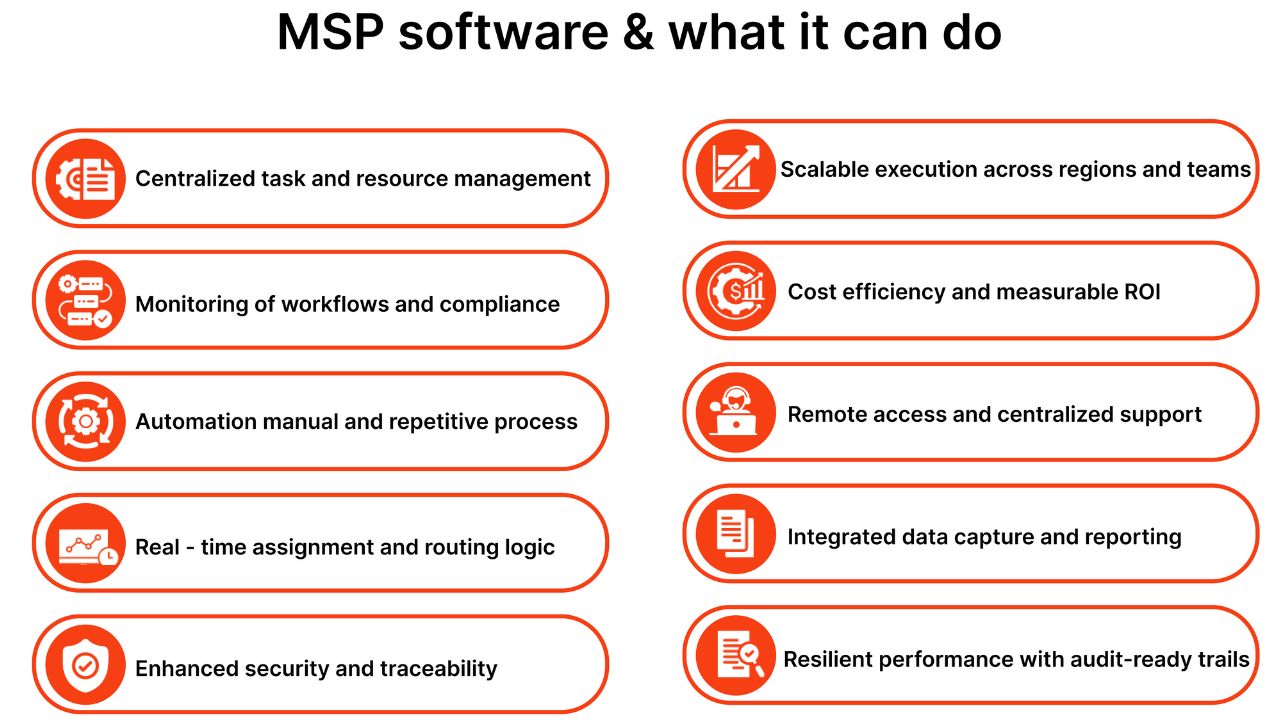
At FieldMaster.ai, we provide a managed service platform (MSP) built to fit real operational needs and help teams work smoothly every day.
Operational Fit Drives Results
What ultimately separates the MSP model from generic platforms is not a list of features—but the way it fits. Fit shows up when the same platform works across locations without forcing workarounds. When auditors can find what they need without a side spreadsheet. When operational change doesn’t feel like technical debt.
That fit isn’t achieved by accident. It comes from designing a system around actual fieldwork—not from reshaping operations around software limitations.
In sectors where delays lead to exposure and disconnected data leads to risk, the MSP model delivers something most platforms don’t: alignment. And that’s what moves work forward.
.png)

"Fieldmaster.ai transformed how we manage our operations across multiple sites. The accuracy we gained from field-first data collection eliminated costly mistakes and saved us months of reconciliation work."
Ready to transform operations
Discover how Fieldmaster helps companies like yours achieve field KPIs with precision and speed.

Stay ahead in the field
Get insights and strategies delivered to your inbox every week from Fieldmaster.
FAQs
Questions about field-first data and how Fieldmaster works
Field-first data is information captured at the source, where work actually happens. Instead of relying on reports compiled hours or days later, it's collected in real-time by workers on the ground. This approach eliminates the gaps and inaccuracies that come from office-based data collection.
FieldMaster AI's mobile app functions completely offline. Workers collect data without internet connectivity, and when the connection returns, all information syncs automatically. Nothing is lost, and operations continue uninterrupted regardless of network conditions.
Yes. Our native mobile app is built with zero-effort multilingual support. Workers of any ethnicity or language background become instantly familiar with the interface. There's no language barrier to adoption or understanding.
It means each user sees only the information relevant to their role. A supervisor has different access than a manager, who has different access than a field worker. This keeps operations organized and ensures people focus on what matters to them.
We've been in business since 2015, starting as field contractors ourselves. That experience shaped everything we built. We've added over $200 million in value to projects across the GCC by focusing on what actually works in the field.